
The Shift to Green Fuels: Economic and Environmental Benefits for Industries
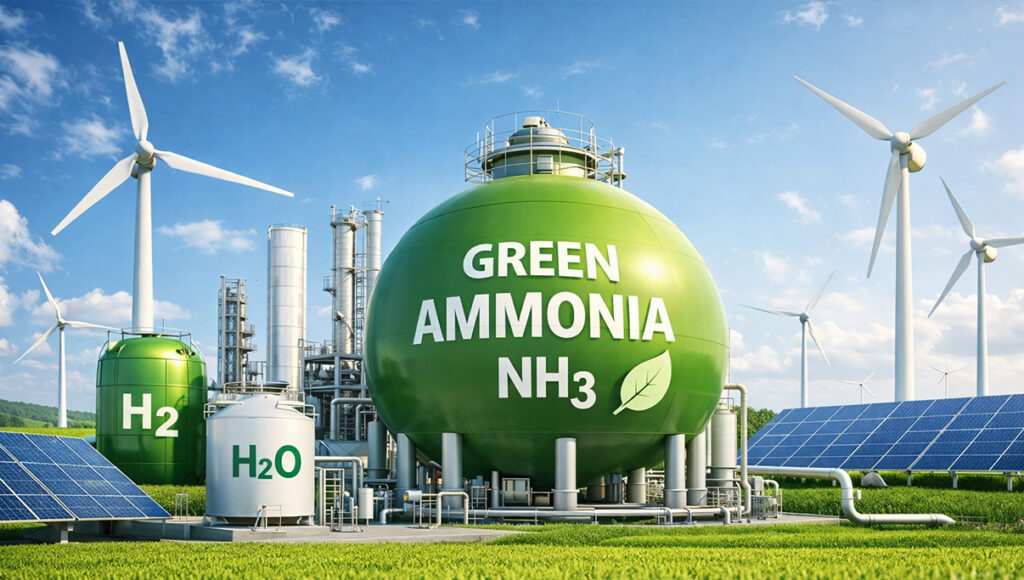
Introduction The global energy system is undergoing a structural transformation as industries seek to reduce greenhouse gas emissions while maintaining reliability and scale. While direct electrification remains the most efficient decarbonisation pathway where feasible, fertilisers, shipping, power generation, chemicals, and heavy industry—are inherently difficult to electrify. For these hard-to-abate applications, energy carriers derived from renewable power, particularly Green Hydrogen and Green Ammonia, are emerging as critical transition enablers. Understanding Green Ammonia Among the available pathways for decarbonisation, Green Ammonia stands out not as an incremental improvement over fossil fuels, but as a fundamental shift in how energy and industrial feedstocks are produced and traded. Conventional Ammonia relies on hydrogen produced from natural gas, embedding significant carbon emissions into a product that underpins global food and industrial systems. Green Ammonia replaces this fossil fuel dependency with Renewable electricity—using Green Hydrogen generated from RE driven electrolysis and combining it with nitrogen sourced directly from air. While the Haber-Bosch synthesis process itself remains unchanged, the upstream energy pathway is fundamentally different, enabling near-zero lifecycle emissions when powered by renewable energy.1 In contrast to Green Ammonia, Blue Ammonia—while benefiting from near-term cost advantages and the ability to leverage existing natural gas infrastructure—continues to rely on fossil fuels and carbon capture. Green Ammonia is thus particularly compelling since it removes carbon from the equation altogether. With no carbon in its molecular structure, Green Ammonia offers a structurally more durable decarbonisation solution. Unlike many other hydrogen derivative alternatives, Green Ammonia benefits from stable pricing of Renewable Energy and future proofing against tightening climate policies and carbon-linked trade mechanisms such as Carbon Border Adjustment Mechanism (“CBAM”). Beyond its emissions profile, Green Ammonia offers system-level advantages that strengthen its role in the energy transition. Ammonia is a globally traded commodity with established storage, transport, and handling infrastructure, making it a practical and scalable carrier for Green Hydrogen. Its higher volumetric energy density relative to hydrogen and its ability to be stored over long durations position it as a viable solution for long-distance energy transport and seasonal energy storage. Importantly, Green Ammonia also provides a means to monetise surplus renewable power, supporting grid stability and improving overall renewable energy system economics. As Renewable Energy costs continue to decline and regulatory pressure on embedded carbon intensifies, Green Ammonia is increasingly positioned not as a niche alternative, but as a cornerstone solution for decarbonisation. Its relevance is therefore not limited to environmental objectives alone, but extends to energy security, trade resilience, and long-term industrial competitiveness. Contribution to Emissions Reduction Goals The central role of Green Fuels is to drive net-zero strategies by enabling deep emissions reductions across sectors where conventional decarbonisation pathways are limited. In particular, multiple lifecycle assessments indicate that Green Ammonia can reduce lifecycle carbon dioxide (CO2) and greenhouse gas (GHG) emissions by 70–95% compared to conventional fuels, depending on the renewable power mix, electrolyser efficiency, and system boundaries applied. In hard-to-abate applications where low-carbon alternatives are scarce—Green Ammonia therefore represents one of the most effective substitution pathways available. Beyond its carbon abatement potential, Green Ammonia also delivers substantial local environmental benefits. When combusted or cracked for energy use, it produces negligible sulphur oxides (SOₓ) and very low particulate matter, besides completely avoiding carbon dioxide emissions at the point of use. These characteristics can significantly improve air quality around industrial facilities, ports, logistics hubs, and urban infrastructure, strengthening the case for Green Ammonia not only as a climate solution but also as a means of addressing public-health and regulatory challenges associated with air pollution.2 Economic Viability and Infrastructure Readiness While ammonia itself is a globally traded commodity with established downstream storage, transport, and handling practices, Green Ammonia does not yet enjoy the same level of infrastructure readiness as Blue Ammonia. Blue Ammonia can be deployed more rapidly in the near term by leveraging existing natural gas supply chains, hydrogen production assets, and, where available, carbon capture infrastructure. Green Ammonia, by contrast, requires the development of a new upstream asset stack— Renewable generation capacity, transmission infrastructure, electrolysers, and dedicated synthesis facilities—making the transition inherently capital intensive and unsuited to simple one-to-one replacement of existing fossil-based systems. These structural differences currently translate into higher production costs for Green Ammonia, leading to pricing in the range of USD 800–1,000 per tonne, driven by electrolyser capital costs, renewable intermittency, and relatively low utilisation factors. Regulatory uncertainty—particularly the absence of fully harmonised global definitions and certification schemes and limited large-scale operational experience, has also contributed to demand-side hesitation and elevated financing risk. However, these challenges are increasingly understood as transitional rather than structural. Rapid scale-up of electrolyser manufacturing, localisation of supply chains, and technology learning curves are expected to materially reduce capital costs and improve efficiency over time. Declining Renewable electricity prices, coupled with emerging carbon pricing mechanisms and targeted government incentives, are steadily narrowing the cost gap between Green Ammonia and fossil-based alternatives. At the system level, hybrid renewable configurations, grid-connected operation, and complementary battery and hydrogen storage solutions are improving utilisation rates and overall project economics. Importantly, while Green Ammonia requires significant upfront infrastructure investment, it offers long-term strategic value that Blue Ammonia cannot fully replicate. Thus, Blue Ammonia can play a pragmatic bridging role, but Green Ammonia is clearly the only scalable end-state solution for deep and lasting decarbonisation across hard-to-abate sectors. Applications Across Multiple Sectors As governments and industries pursue credible net-zero pathways, Green Ammonia is increasingly coming into focus as a solution that can potentially be deployed at scale across multiple sectors without compromising on energy security or operational continuity. Power Generation and Energy Systems Green Ammonia can be utilised directly in thermal power generation or cracked to produce hydrogen for use in gas turbines and fuel cells, offering a low-carbon pathway for dispatchable and firm power generation. While it is not yet a drop-in replacement for conventional fuels, it is increasingly being evaluated as a co-firing option to reduce emissions from existing thermal assets.3 Green Ammonia’s ability to function as a form of long-duration energy storage—converting variable