Synergen Green Energy

Author name: synergenadmin

Synergen Green Energy - Green Ammonia
Blog

The Shift to Green Fuels: Economic and Environmental Benefits for Industries

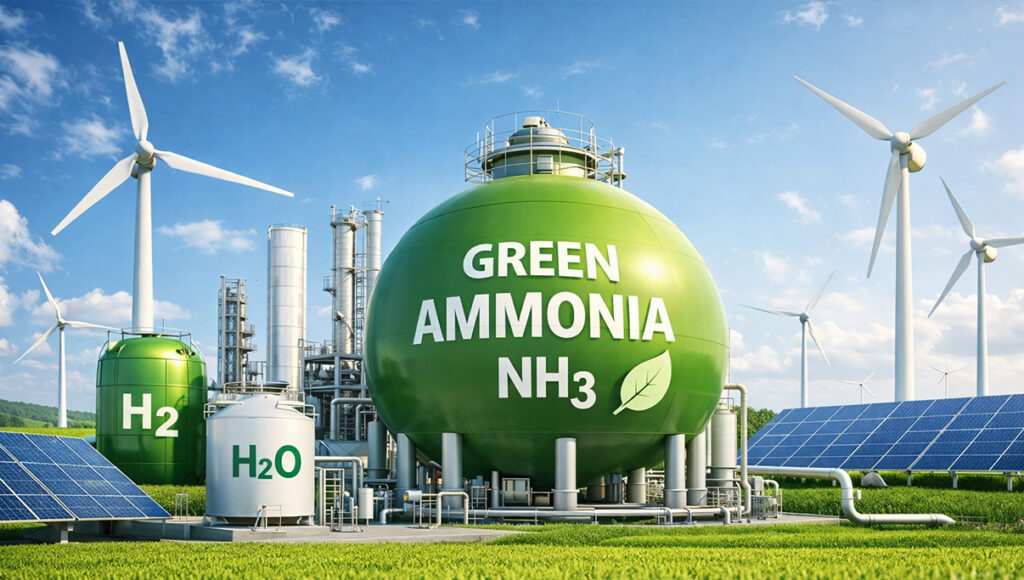
Introduction The global energy system is undergoing a structural transformation as industries seek to reduce greenhouse gas emissions while maintaining reliability and scale. While direct electrification remains the most efficient decarbonisation pathway where feasible, fertilisers, shipping, power generation, chemicals, and heavy industry—are inherently difficult to electrify. For these hard-to-abate applications, energy carriers derived from renewable power, particularly Green Hydrogen and Green Ammonia, are emerging as critical transition enablers. Understanding Green Ammonia Among the available pathways for decarbonisation, Green Ammonia stands out not as an incremental improvement over fossil fuels, but as a fundamental shift in how energy and industrial feedstocks are produced and traded. Conventional Ammonia relies on hydrogen produced from natural gas, embedding significant carbon emissions into a product that underpins global food and industrial systems. Green Ammonia replaces this fossil fuel dependency with Renewable electricity—using Green Hydrogen generated from RE driven electrolysis and combining it with nitrogen sourced directly from air. While the Haber-Bosch synthesis process itself remains unchanged, the upstream energy pathway is fundamentally different, enabling near-zero lifecycle emissions when powered by renewable energy.1 In contrast to Green Ammonia, Blue Ammonia—while benefiting from near-term cost advantages and the ability to leverage existing natural gas infrastructure—continues to rely on fossil fuels and carbon capture. Green Ammonia is thus particularly compelling since it removes carbon from the equation altogether. With no carbon in its molecular structure, Green Ammonia offers a structurally more durable decarbonisation solution. Unlike many other hydrogen derivative alternatives, Green Ammonia benefits from stable pricing of Renewable Energy and future proofing against tightening climate policies and carbon-linked trade mechanisms such as Carbon Border Adjustment Mechanism (“CBAM”). Beyond its emissions profile, Green Ammonia offers system-level advantages that strengthen its role in the energy transition. Ammonia is a globally traded commodity with established storage, transport, and handling infrastructure, making it a practical and scalable carrier for Green Hydrogen. Its higher volumetric energy density relative to hydrogen and its ability to be stored over long durations position it as a viable solution for long-distance energy transport and seasonal energy storage. Importantly, Green Ammonia also provides a means to monetise surplus renewable power, supporting grid stability and improving overall renewable energy system economics. As Renewable Energy costs continue to decline and regulatory pressure on embedded carbon intensifies, Green Ammonia is increasingly positioned not as a niche alternative, but as a cornerstone solution for decarbonisation. Its relevance is therefore not limited to environmental objectives alone, but extends to energy security, trade resilience, and long-term industrial competitiveness. Contribution to Emissions Reduction Goals The central role of Green Fuels is to drive net-zero strategies by enabling deep emissions reductions across sectors where conventional decarbonisation pathways are limited. In particular, multiple lifecycle assessments indicate that Green Ammonia can reduce lifecycle carbon dioxide (CO2) and greenhouse gas (GHG) emissions by 70–95% compared to conventional fuels, depending on the renewable power mix, electrolyser efficiency, and system boundaries applied. In hard-to-abate applications where low-carbon alternatives are scarce—Green Ammonia therefore represents one of the most effective substitution pathways available. Beyond its carbon abatement potential, Green Ammonia also delivers substantial local environmental benefits. When combusted or cracked for energy use, it produces negligible sulphur oxides (SOₓ) and very low particulate matter, besides completely avoiding carbon dioxide emissions at the point of use. These characteristics can significantly improve air quality around industrial facilities, ports, logistics hubs, and urban infrastructure, strengthening the case for Green Ammonia not only as a climate solution but also as a means of addressing public-health and regulatory challenges associated with air pollution.2 Economic Viability and Infrastructure Readiness While ammonia itself is a globally traded commodity with established downstream storage, transport, and handling practices, Green Ammonia does not yet enjoy the same level of infrastructure readiness as Blue Ammonia. Blue Ammonia can be deployed more rapidly in the near term by leveraging existing natural gas supply chains, hydrogen production assets, and, where available, carbon capture infrastructure. Green Ammonia, by contrast, requires the development of a new upstream asset stack— Renewable generation capacity, transmission infrastructure, electrolysers, and dedicated synthesis facilities—making the transition inherently capital intensive and unsuited to simple one-to-one replacement of existing fossil-based systems. These structural differences currently translate into higher production costs for Green Ammonia, leading to pricing in the range of USD 800–1,000 per tonne, driven by electrolyser capital costs, renewable intermittency, and relatively low utilisation factors. Regulatory uncertainty—particularly the absence of fully harmonised global definitions and certification schemes and limited large-scale operational experience, has also contributed to demand-side hesitation and elevated financing risk. However, these challenges are increasingly understood as transitional rather than structural. Rapid scale-up of electrolyser manufacturing, localisation of supply chains, and technology learning curves are expected to materially reduce capital costs and improve efficiency over time. Declining Renewable electricity prices, coupled with emerging carbon pricing mechanisms and targeted government incentives, are steadily narrowing the cost gap between Green Ammonia and fossil-based alternatives. At the system level, hybrid renewable configurations, grid-connected operation, and complementary battery and hydrogen storage solutions are improving utilisation rates and overall project economics. Importantly, while Green Ammonia requires significant upfront infrastructure investment, it offers long-term strategic value that Blue Ammonia cannot fully replicate. Thus, Blue Ammonia can play a pragmatic bridging role, but Green Ammonia is clearly the only scalable end-state solution for deep and lasting decarbonisation across hard-to-abate sectors. Applications Across Multiple Sectors As governments and industries pursue credible net-zero pathways, Green Ammonia is increasingly coming into focus as a solution that can potentially be deployed at scale across multiple sectors without compromising on energy security or operational continuity. Power Generation and Energy Systems Green Ammonia can be utilised directly in thermal power generation or cracked to produce hydrogen for use in gas turbines and fuel cells, offering a low-carbon pathway for dispatchable and firm power generation. While it is not yet a drop-in replacement for conventional fuels, it is increasingly being evaluated as a co-firing option to reduce emissions from existing thermal assets.3 Green Ammonia’s ability to function as a form of long-duration energy storage—converting variable
Electric Hydrogen selected by Synergen Green Energy
Press Releases

Electric Hydrogen selected by Synergen Green Energy for 240 MW U.S. green ammonia project

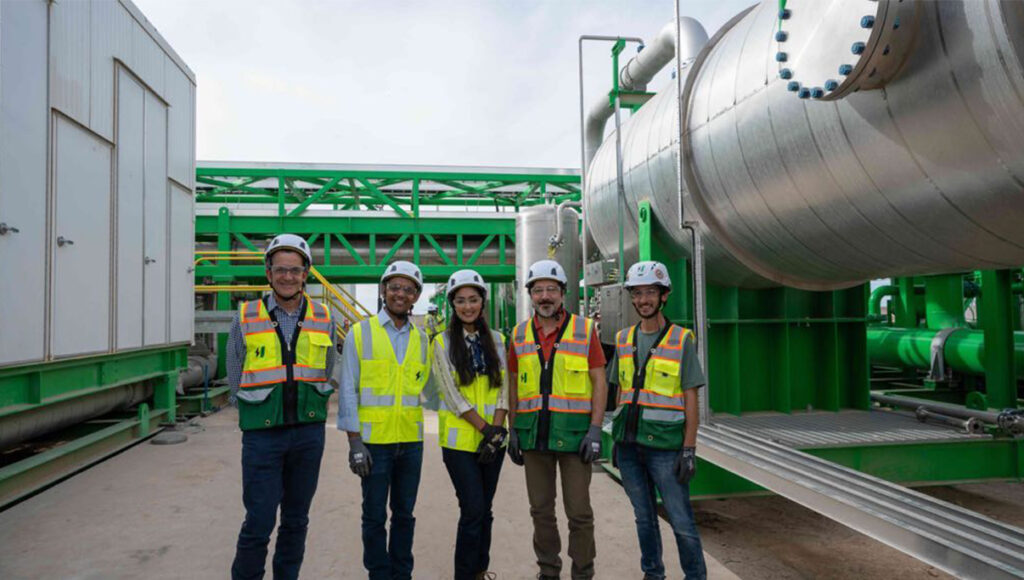
Electric Hydrogen, U.S. manufacturer of advanced electrolyzer plants, today announced it has been selected by Synergen Green Energy Inc., a leading commercial-scale developer of green hydrogen and ammonia facilities, for its state-of-the-art advanced fuels project in the United States. Electric Hydrogen will support integration of two of its flagship 120 MW HYPRPlants as part of the front-end engineering and design (FEED) agreement for this project. Once constructed, the facility will be capable of producing approximately 210,000 tons per annum (TPA) of ammonia for maritime and industrial applications in Europe and Asia. This is the third large-scale renewable hydrogen project in the US to select Electric Hydrogen’s advanced proton exchange membrane (PEM) technology. Electric Hydrogen is currently deploying its first 100 MW HYPRPlant at Infinium’s Project Roadrunner site in Pecos, Texas. The company has also been selected by HIF Global for its Texas-based e-fuels facility. Electric Hydrogen’s innovative HYPRPlant technology, the most powerful, lowest-cost electrolzyer plant on the global market leverages proprietary PEM technology and renewable electricity to produce cost-competitive clean hydrogen at industrial scale. The entire hydrogen production plant is delivered on factory‑fabricated skids and assembled by local partners, helping customers reduce total installed costs by as much as 60%. “Electric Hydrogen is redefining what’s possible for clean hydrogen production through its efficient electrolysis technology,” said Pranav Tanti, CEO of Synergen Green Energy. “Achieving total installed costs less than $1000/kW is crucial to our ability to produce green ammonia economically at scale. The unique approach that Electric Hydrogen brings to electrolyzer design and manufacturing aligns with Synergen’s own standardization and modular design philosophy. We look forward to building a strong and enduring collaboration with our partners at Electric Hydrogen.” “Our HYPRPlant technology makes it possible for customers like Synergen Green Energy to produce radically low-cost hydrogen today,” said Raffi Garabedian, CEO of Electric Hydrogen.  “This collaboration reflects our shared commitment to accelerating the energy transition and delivering scalable solutions to enable new advanced fuel economies in the US and globally.” The project is expected to achieve reach final investment decision in 2026, and the facility is targeted to be operational at the end of 2028. About Synergen Green Energy Synergen Green Energy is a leading commercial-scale developer of state-of-the-art green hydrogen and ammonia facilities. Utilizing on its group’s 30+ years of extensive global experience in renewable energy, Synergen is developing a standardized and modularized approach to its entire portfolio of projects. Synergen aims to be a pioneer in bringing the most cost competitive green fuels to the market. We are advancing our portfolio of projects across the United States and India to supply cost-competitive clean fuels to global markets. Our mission is to accelerate the energy transition by making clean hydrogen and its derivatives accessible, and affordable for global end users. Synergen was founded in 2022 and is headquartered in Houston, TX. To learn more, please visit: www.synergengreen.com About Electric HydrogenElectric Hydrogen manufactures, delivers and commissions the world’s most powerful electrolyzers to make clean hydrogen projects economically viable today. The company’s complete HYPRPlant includes all system components required to turn water and electricity into the lowest cost clean hydrogen. Electric Hydrogen has a team of more than 300 people in the United States and Europe. The company was founded in 2020 and is headquartered in Devens, Massachusetts. To learn more about how critical industries leverage Electric Hydrogen’s advanced PEM technology, visit https://eh2.com/

Creating scalable and sustainable solutions
Press Releases

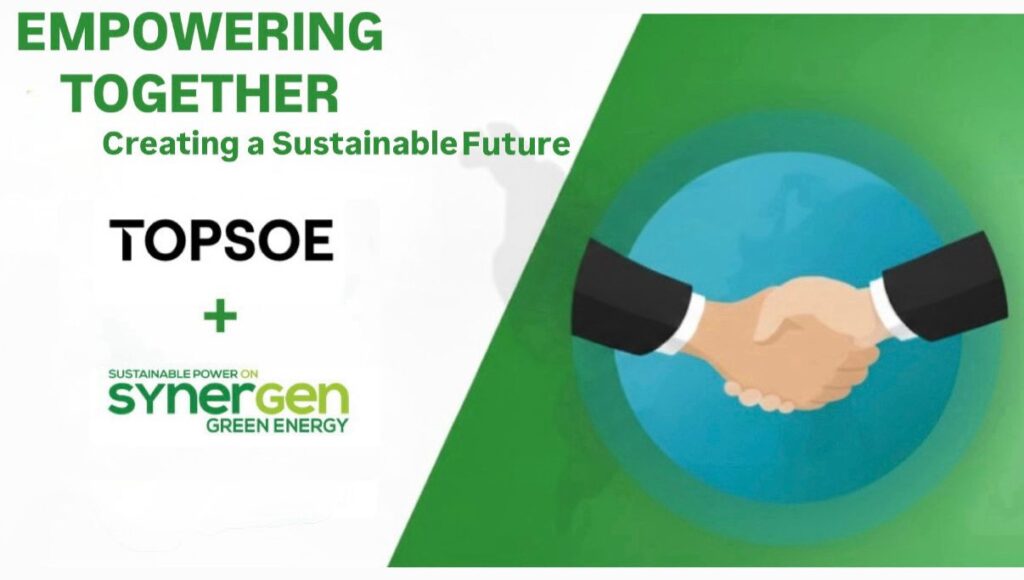
Synergen Green Energy, Topsoe, and The Shaw Group Form a Partnership for Modular Green Ammonia Facility in Texas 

Synergen Green Energy Inc., Topsoe Inc. and The Shaw Group LLC, through its Shaw Projects & Modules business unit, have entered into a collaborative agreement to advance the development of 600 metric tons per day (MTPD) modular green ammonia facilities across the US.    These facilities are designed to employ Topsoe’s dynamic ammonia technology, which integrates proprietary processes, equipment, and catalysts to produce green ammonia using renewable energy sources. This collaborative agreement is a significant step towards Synergen Green Energy’s broader initiative to establish scalable green ammonia production facilities in the United States and abroad.    Under the agreement, Shaw will provide Front-End Engineering Design (FEED) services to support the project, which will utilize Topsoe’s proprietary green ammonia technology. The FEED scope is expected to take approximately eight months. Following completion of the FEED phase, Shaw will fabricate the modules at its module fabrication facility in Beaumont, Texas.   “Green ammonia is poised to become one of the most critical commodities of the energy transition, and our presence in both the U.S. and India allows us to pioneer solutions that work across different regulatory environments and market dynamics. This nascent industry needs partnerships to forge the way ahead and make green fuel projects economically viable and competitive,” said Pranav Tanti, CEO of Synergen Green Energy. “We are excited to partner with renowned companies like The Shaw Group for their modular engineering and fabrication expertise and Topsoe for their innovative synloop technology. This partnership strengthens our ability to deploy proven technology at scale while continuing to innovate. Together we’re not just producing green ammonia – we’re creating a global platform for sustainable solutions that will enable clean shipping, power industrial sectors and support grid-scale energy storage for decades to come.”  “Green ammonia will add to the diversification of the fuel sources available to industry. The close collaboration with Synergen and The Shaw group to progress Synergen’s green ammonia project has been excellent,” said Henrik Rasmussen, Managing Director of Topsoe Americas. “We are excited to provide our dynamic ammonia loop technology for the project and look forward to working with the talented teams from Synergen and The Shaw group.”  “This collaboration reflects the strengths each partner brings to advancing clean energy infrastructure,” said Dan Simpson, CEO of The Shaw Group. “By combining Shaw’s modular engineering and fabrication expertise with Topsoe’s proven technology and Synergen’s project vision, we are supporting the development of practical, low-carbon solutions.”  About Synergen Green Energy:    Synergen Green Energy is a leading commercial-scale developer of state-of-the-art green hydrogen and ammonia facilities. Utilizing its group’s 30+ years of extensive global experience in renewable energy, Synergen is developing a standardized and modularized approach to its entire portfolio of projects. Synergen aims to be a pioneer in bringing the most cost competitive green fuels to the market. We are advancing our portfolio of projects across the United States and India to supply cost-competitive clean fuels to global markets. Our mission is to accelerate the energy transition by making clean hydrogen and ammonia accessible, affordable, and transformative for global end users. Synergen was founded in 2022 and is headquartered in Houston, TX. To learn more, please visit: www.synergengreen.com  About Topsoe:   Topsoe is a leading global provider of advanced technology and solutions for the energy transition. Built on decades of scientific research and innovation, we are working with customers and partners to drive energy resiliency and to achieve their sustainability goals. We offer world-leading solutions for transforming renewable resources into fuels and chemicals, and we provide the technologies needed to produce low-carbon and conventional fuels and chemicals, as well as to ensure clean air. We were founded in 1940 and are headquartered in Denmark, with over 2,800 employees serving customers worldwide. To learn more, visit www.topsoe.com.   About Shaw Projects & Modules:  Shaw Projects & Modules, a business unit of The Shaw Group, is a premier provider of engineering, procurement, fabrication (EPF), and project services. Formed through the combination of Chemex Global, founded in 1978 and acquired in 2021, and KP Engineering, founded in 2004 and acquired in 2023, along with Shaw’s world-class modular fabrication facilities in Lake Charles, Louisiana, and Beaumont, Texas, Shaw Projects & Modules brings together decades of engineering excellence, including over 30 years of expertise in modularization. The company delivers comprehensive project solutions from concept to completion, making it a trusted partner for large-scale industrial projects. To learn more, visit www.theshawgrp.com.

Synergen - Topsoe
Press Releases

Synergen Green Energy Partners with Leading Technology Provider to Enable Green Ammonia Production

Topsoe, a leading global provider of advanced technology and solutions for the energy transition, announced today that it has been selected to deliver its dynamic ammonia loop technology, as well as proprietary catalysts and equipment, for Synergen Green Energy’s ammonia project in the U.S. The first project, when operational, will be designed to produce 210,000 metric tons of ammonia annually and will avoid approximately 400,000 tons of CO₂ emissions – the equivalent of removing around 95,000 gasoline-powered passenger cars from the road for one year. The ammonia will be produced utilizing renewable electricity and used for the export market. Henrik Rasmussen, Managing Director of Topsoe Americas, said:“We’re thrilled that Synergen selected Topsoe to collaborate on their impressive next generation ammonia projects. Green ammonia will add to the diversification of the fuel sources available to industry. We look forward to working with the talented team from Synergen.” Synergen Green Energy CEO Pranav Tanti added:“Green fuels are the beginning of a new era for the world. We are excited to partner with a renowned company like Topsoe for their innovative synloop technology that adapts to intermittent power supply. This nascent industry needs partnerships to forge the way ahead and make green fuel projects economically viable, and green ammonia globally competitive. We, at Synergen, remain committed to this cause, and look forward to a long term and successful relationship with Topsoe.”  Ammonia – either in the form of an e-fuel (green ammonia) or in the form of low-carbon ammonia (blue ammonia) is expected to play a critical role in the energy transition. It can be transported using existing ammonia infrastructure; and it has multiple end-uses, not only as a fuel or hydrogen carrier but also to help decarbonize industrial processes like steel and cement production. What is Topsoe’s dynamic ammonia technologyTopsoe’s dynamic ammonia technology adapts the production output of green ammonia in response to fluctuating supply of renewable electricity. The dynamic ammonia process plant will enable: Read more about Topsoe’s ammonia solutions here. About Synergen Green EnergySynergen Green Energy is a leading commercial-scale developer of clean hydrogen and ammonia. We are advancing a portfolio of projects across the United States and India to supply cost-competitive clean fuels to global markets. Our mission is to accelerate the energy transition by making clean hydrogen and ammonia accessible, affordable, and transformative for global end users. Synergen was founded in 2022 and is headquartered in Houston, TX. For more information, please contact: Mail: contact.usa@synergengreen.com About TopsoeTopsoe is a leading global provider of advanced technology and solutions for the energy transition. Built on decades of scientific research and innovation, we are working with customers and partners to drive energy resiliency and to achieve their sustainability goals. We offer world-leading solutions for transforming renewable resources into fuels and chemicals, and we provide technologies needed to produce low-carbon and conventional fuels and chemicals as well as ensuring clean air. We were founded in 1940 and are headquartered in Denmark, with over 2,800 employees serving customers all around the globe. To learn more, visit www.topsoe.com.  For more information, please contact: Mail: gama@topsoe.com

Uncategorized

What is Lorem Ipsum? – Copy – Copy

Lorem Ipsum is simply dummy text of the printing and typesetting industry. Lorem Ipsum has been the industry’s standard dummy text ever since the 1500s, when an unknown printer took a galley of type and scrambled it to make a type specimen book. It has survived not only five centuries, but also the leap into electronic typesetting, remaining essentially unchanged. It was popularised in the 1960s with the release of Letraset sheets containing Lorem Ipsum passages, and more recently with desktop publishing software like Aldus PageMaker including versions of Lorem Ipsum. Where does it come from? Contrary to popular belief, Lorem Ipsum is not simply random text. It has roots in a piece of classical Latin literature from 45 BC, making it over 2000 years old. Richard McClintock, a Latin professor at Hampden-Sydney College in Virginia, looked up one of the more obscure Latin words, consectetur, from a Lorem Ipsum passage, and going through the cites of the word in classical literature, discovered the undoubtable source. Lorem Ipsum comes from sections 1.10.32 and 1.10.33 of “de Finibus Bonorum et Malorum” (The Extremes of Good and Evil) by Cicero, written in 45 BC. This book is a treatise on the theory of ethics, very popular during the Renaissance. The first line of Lorem Ipsum, “Lorem ipsum dolor sit amet..”, comes from a line in section 1.10.32. The standard chunk of Lorem Ipsum used since the 1500s is reproduced below for those interested. Sections 1.10.32 and 1.10.33 from “de Finibus Bonorum et Malorum” by Cicero are also reproduced in their exact original form, accompanied by English versions from the 1914 translation by H. Rackham.

Uncategorized

What is Lorem Ipsum? – Copy

Lorem Ipsum is simply dummy text of the printing and typesetting industry. Lorem Ipsum has been the industry’s standard dummy text ever since the 1500s, when an unknown printer took a galley of type and scrambled it to make a type specimen book. It has survived not only five centuries, but also the leap into electronic typesetting, remaining essentially unchanged. It was popularised in the 1960s with the release of Letraset sheets containing Lorem Ipsum passages, and more recently with desktop publishing software like Aldus PageMaker including versions of Lorem Ipsum. Where does it come from? Contrary to popular belief, Lorem Ipsum is not simply random text. It has roots in a piece of classical Latin literature from 45 BC, making it over 2000 years old. Richard McClintock, a Latin professor at Hampden-Sydney College in Virginia, looked up one of the more obscure Latin words, consectetur, from a Lorem Ipsum passage, and going through the cites of the word in classical literature, discovered the undoubtable source. Lorem Ipsum comes from sections 1.10.32 and 1.10.33 of “de Finibus Bonorum et Malorum” (The Extremes of Good and Evil) by Cicero, written in 45 BC. This book is a treatise on the theory of ethics, very popular during the Renaissance. The first line of Lorem Ipsum, “Lorem ipsum dolor sit amet..”, comes from a line in section 1.10.32. The standard chunk of Lorem Ipsum used since the 1500s is reproduced below for those interested. Sections 1.10.32 and 1.10.33 from “de Finibus Bonorum et Malorum” by Cicero are also reproduced in their exact original form, accompanied by English versions from the 1914 translation by H. Rackham.

Uncategorized

What is Lorem Ipsum? – Copy

Lorem Ipsum is simply dummy text of the printing and typesetting industry. Lorem Ipsum has been the industry’s standard dummy text ever since the 1500s, when an unknown printer took a galley of type and scrambled it to make a type specimen book. It has survived not only five centuries, but also the leap into electronic typesetting, remaining essentially unchanged. It was popularised in the 1960s with the release of Letraset sheets containing Lorem Ipsum passages, and more recently with desktop publishing software like Aldus PageMaker including versions of Lorem Ipsum. Where does it come from? Contrary to popular belief, Lorem Ipsum is not simply random text. It has roots in a piece of classical Latin literature from 45 BC, making it over 2000 years old. Richard McClintock, a Latin professor at Hampden-Sydney College in Virginia, looked up one of the more obscure Latin words, consectetur, from a Lorem Ipsum passage, and going through the cites of the word in classical literature, discovered the undoubtable source. Lorem Ipsum comes from sections 1.10.32 and 1.10.33 of “de Finibus Bonorum et Malorum” (The Extremes of Good and Evil) by Cicero, written in 45 BC. This book is a treatise on the theory of ethics, very popular during the Renaissance. The first line of Lorem Ipsum, “Lorem ipsum dolor sit amet..”, comes from a line in section 1.10.32. The standard chunk of Lorem Ipsum used since the 1500s is reproduced below for those interested. Sections 1.10.32 and 1.10.33 from “de Finibus Bonorum et Malorum” by Cicero are also reproduced in their exact original form, accompanied by English versions from the 1914 translation by H. Rackham.

Uncategorized

What is Lorem Ipsum?

Lorem Ipsum is simply dummy text of the printing and typesetting industry. Lorem Ipsum has been the industry’s standard dummy text ever since the 1500s, when an unknown printer took a galley of type and scrambled it to make a type specimen book. It has survived not only five centuries, but also the leap into electronic typesetting, remaining essentially unchanged. It was popularised in the 1960s with the release of Letraset sheets containing Lorem Ipsum passages, and more recently with desktop publishing software like Aldus PageMaker including versions of Lorem Ipsum. Where does it come from? Contrary to popular belief, Lorem Ipsum is not simply random text. It has roots in a piece of classical Latin literature from 45 BC, making it over 2000 years old. Richard McClintock, a Latin professor at Hampden-Sydney College in Virginia, looked up one of the more obscure Latin words, consectetur, from a Lorem Ipsum passage, and going through the cites of the word in classical literature, discovered the undoubtable source. Lorem Ipsum comes from sections 1.10.32 and 1.10.33 of “de Finibus Bonorum et Malorum” (The Extremes of Good and Evil) by Cicero, written in 45 BC. This book is a treatise on the theory of ethics, very popular during the Renaissance. The first line of Lorem Ipsum, “Lorem ipsum dolor sit amet..”, comes from a line in section 1.10.32. The standard chunk of Lorem Ipsum used since the 1500s is reproduced below for those interested. Sections 1.10.32 and 1.10.33 from “de Finibus Bonorum et Malorum” by Cicero are also reproduced in their exact original form, accompanied by English versions from the 1914 translation by H. Rackham.

Scroll to Top